Cloud Security
Cloud-Native Security in 2026: Container and Kubernetes Threats, Hardening, and Runtime Defense
A beginner-friendly 2026 guide to cloud-native security: container and Kubernetes threats, image scanning, RBAC, secrets, admission control, CNAPP, hardening, and runtime defense.
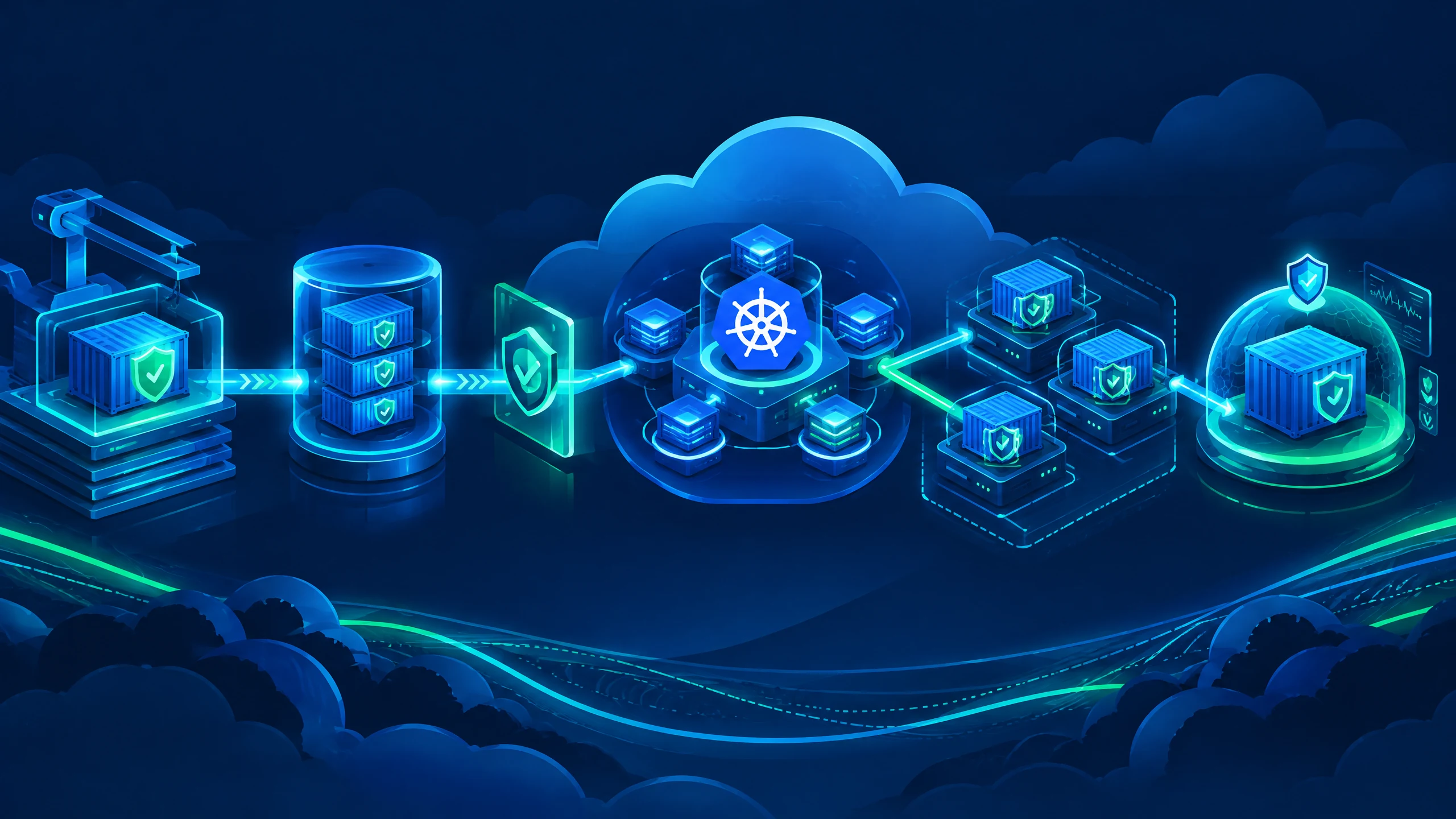
Cloud-native security in 2026 is a lifecycle discipline, not a single scanner or Kubernetes setting. The practical answer is to protect every transition: build a trusted image, store and move it safely, enforce policy before deployment, limit what workloads can access, harden nodes and the control plane, and detect suspicious behavior at runtime. This approach connects container security, Kubernetes security best practices, software supply chain controls, and runtime defense into one operating model. **Key Takeaways** - Treat the path from source code to running pod as one security lifecycle. A clean runtime cannot compensate for an untrusted image or weak registry controls. - Use least-privilege RBAC, short-lived workload identity, encrypted secrets, and admission policies to prevent avoidable privilege and configuration mistakes. - Harden the control plane and nodes, segment workloads with network policy, and monitor runtime behavior rather than relying on image scanning alone. - A CNAPP can unify posture, workload, identity, and runtime signals, but it still needs clear ownership, policy exceptions, and response playbooks. - Exact Google Trends numeric scores are unavailable for this draft; the 2026 trend discussion uses qualitative signals from current Kubernetes and government guidance instead.
Why cloud-native security matters in 2026
Cloud-native systems move quickly. A commit can trigger a build, an image can move through registries, and an orchestrator can schedule it across changing nodes. Every handoff creates a place where trust, identity, configuration, or visibility can fail.
The threat is broader than a vulnerable package. Common risks include poisoned images, exposed registries, overpowered service accounts, leaked secrets, unsafe admission exceptions, public control-plane endpoints, weak node isolation, and suspicious activity that begins after deployment. A Kubernetes cluster also contains high-value paths: the API server, etcd, controllers, schedulers, kubelets, identity providers, and admission webhooks.
The 2026 conversation is shifting from “scan the container” to “secure the whole workload graph,” with more attention to CNAPP, software provenance, policy-as-code, identity-aware controls, and runtime security. These directions do not replace fundamentals.
For a broader view of how a cloud misconfiguration can become a security incident, see [our guide to cloud security misconfiguration](/articles/cloud-security-misconfiguration). For a wider set of defensive concepts, visit [the cloud security topic hub](/topics/cloud-security) and [the network security topic hub](/topics/network-security).
What are the main container and Kubernetes threats?
The main threats fall into five connected areas: the image and build pipeline, the registry, the Kubernetes control plane, the worker nodes and network, and the running workload. Separating them helps a beginner identify the right owner and control.
### 1. Image and build threats
A container image packages application code, operating-system components, libraries, and metadata. It may inherit risk from a base image, a dependency, a build tool, or a pipeline credential. A scanner can find known vulnerabilities, but a scan does not prove that the image came from an approved build or that it has not been altered.
Use small, maintained base images; pin dependencies where practical; remove compilers and debugging tools from production images; and generate a software bill of materials (SBOM). Scan images during pull-request review, build, registry promotion, and deployment. Prioritize exploitable exposure, reachable components, workload sensitivity, and available fixes instead of treating every finding as equally urgent.
### 2. Registry and supply-chain threats
Registries are part of the security boundary. Risks include anonymous access, overly broad push permissions, mutable tags, copied images with unclear provenance, and credentials shared between environments. A production cluster should pull from an approved registry through an authenticated path, with retention, audit logging, and clear ownership.
Prefer immutable digests or signed artifacts over a tag that can silently point to a different image. Verify provenance at the point of deployment, not only in the build system. Keep development, staging, and production promotion paths distinct, and make emergency exceptions visible and time-limited. The same principle applies to Helm charts, operators, policy bundles, and other deployment dependencies.
For a deeper explanation of poisoned dependencies and build-system trust, place a link here to [our software supply-chain attacks guide](/articles/software-supply-chain-attacks).
### 3. Control-plane threats
The **control plane** is the management layer that stores and applies the desired state of a cluster. It includes the Kubernetes API server, scheduler, controller managers, and usually etcd, the key-value datastore. If an unauthorized identity can change the API objects, it may influence workload placement, credentials, network paths, or persistent data.
Protect the API server with strong authentication, narrowly scoped authorization, administrative access controls, and audit logs. Do not expose etcd or the kubelet API to the public internet. Restrict management paths to approved networks, protect the certificate authority and backups, and review admission webhooks as security-sensitive extensions.
### 4. Node and network threats
A **node** is the worker machine that runs pods. It includes the operating system, kernel, kubelet, container runtime, storage, network components, and cloud permissions. A node compromise can affect more than one pod, so host patching, restricted administrative access, endpoint monitoring, and workload placement matter.
Use supported node images and a controlled patch process. Minimize host packages and privileges. Keep sensitive workloads away from less-trusted workloads where the risk justifies isolation, using placement rules, dedicated pools, or a stronger sandboxed runtime. Apply default-deny network policies, then allow required ingress and egress. Filter metadata access and restrict externally exposed services.
### 5. Runtime threats
Runtime security** focuses on what a deployed container and its process tree do after launch. Useful signals include unexpected binaries, access to sensitive host paths, unusual privilege changes, unexpected network destinations, abnormal identity use, and behavior that conflicts with the workload’s declared purpose.
Runtime controls should be proportionate. Start with baselines for critical workloads, enrich alerts with pod, namespace, image digest, service account, node, and deployment metadata, and define a safe response such as isolation, credential rotation, or redeployment from a known-good artifact.
How to harden Kubernetes without losing operational clarity
Hardening works best when the cluster has a small number of explicit guardrails and a documented exception process. The following controls cover the areas most likely to create avoidable blast radius.
### RBAC: give identities only the access they need
Kubernetes **RBAC**, or role-based access control, determines which users, groups, and service accounts can perform actions on which resources. Begin with namespace-scoped Roles and RoleBindings where possible. Avoid wildcard permissions and routine use of cluster-admin. Review access to secrets, workload creation, persistent volumes, impersonation, and node-related resources with particular care because these permissions can enable indirect privilege escalation.
Use a separate service account per workload or trust boundary. Disable automatic service-account token mounting for pods that do not need Kubernetes API access. Prefer short-lived, audience-bound workload identity where the platform supports it. Review bindings periodically, remove stale identities, and log sensitive administrative activity. RBAC is not a substitute for workload isolation: a user who can create a dangerous workload may gain access to resources that the role list does not make obvious.
Readers who want a focused example can continue with [our Kubernetes operator security and RBAC risk article](/articles/kubernetes-operator-security-rbac-risk).
### Secrets management: reduce exposure and shorten lifetime
Kubernetes Secrets are an API resource, not automatically a complete secrets-management program. Do not place confidential values in ConfigMaps, images, source repositories, or ordinary build logs. Encrypt secrets at rest in the datastore, restrict who can read or list them, and avoid mounting them into workloads that do not need them.
Where appropriate, retrieve secrets from an external manager through a controlled integration, preferably as a file or volume with a defined lifetime rather than a broadly visible environment variable. Rotate credentials after suspected exposure, and record who owns rotation and how applications reload values. Remember that a workload with permission to create arbitrary pods in a namespace may be able to access resources mounted into those pods; permissions must be assessed as a chain, not one verb at a time.
### Admission control: stop unsafe workloads before persistence
Admission control** is the policy gate between an API request and the object being accepted by the cluster. Validating policies can reject risky requests; mutating policies can apply safe defaults. Use Pod Security Admission or an equivalent policy layer to require non-privileged defaults, controlled capabilities, approved volume types, and appropriate user and filesystem settings.
Add rules for trusted registries, image signatures or provenance, vulnerability thresholds, resource requests and limits, host-network and host-path restrictions, approved namespaces, and required labels. Test policies in audit or warning modes before enforcement, then create an exception path with an owner, reason, expiration, and review date. Secure the webhooks themselves, including their certificates, network access, availability behavior, and permissions.
### Control plane and node hardening
Keep the API server, etcd, and kubelet management interfaces private wherever possible. Protect the root and intermediate certificate authorities. Enable audit logging, retain it according to risk and policy, and restrict access to the logs. Ensure administrative credentials are individual, strongly authenticated, and traceable.
On nodes, patch the operating system and container runtime, restrict direct shell access, and use host security controls appropriate to the environment. Separate high-sensitivity workloads from public-facing or untrusted workloads when practical. Select a more isolated runtime for workloads that need stronger boundaries, accepting the operational and performance trade-offs. Treat node labels, taints, and placement rules as security controls that require change review.
Image scanning and software supply-chain checks
Image scanning is necessary but incomplete. Combine vulnerability analysis with image construction, provenance, configuration, and runtime context. Scan the final production image, not only an intermediate layer. Fail builds for defined high-risk conditions, with a documented process for accepted risk when a fix is unavailable or a finding is not reachable.
The lifecycle should also include secret detection, SBOM generation, dependency review, signature or attestation verification, and monitoring for newly disclosed vulnerabilities after release. Track the image by digest so a redeploy is reproducible. Preserve the relationship between source revision, build identity, dependencies, test results, and artifact digest.
The aim is not to promise a vulnerability-free image. It is to make the decision auditable: what was built, from which inputs, under which policy, and why it was allowed into production.
A practical cloud-native security lifecycle checklist
Use this checklist from image build to runtime. Adapt the owner and evidence fields to your delivery process.
1. **Source and build:** protect repository branches and CI credentials; review dependencies; generate an SBOM; keep secrets out of build output; use reproducible or otherwise traceable builds.
2. **Image quality:** use maintained base images; remove unnecessary packages; run as a non-root user where compatible; set a read-only filesystem when practical; scan the final image and record findings.
3. **Provenance and registry:** sign or attest approved artifacts; restrict push and delete permissions; prefer immutable digests; separate environments; enable registry audit logs and retention controls.
4. **Deployment policy:** verify image origin and digest; enforce Pod Security Admission or equivalent policy; restrict privileged mode, host namespaces, unsafe volumes, and unapproved registries; require resource limits and security metadata.
5. **Identity and secrets:** assign a minimal service account; disable unused token automounting; use workload identity where available; encrypt secrets; limit read and list permissions; define rotation and revocation procedures.
6. **Control plane:** protect API-server access; restrict etcd and kubelet interfaces; secure certificate authorities; enable audit logging; review RBAC, admission webhooks, and administrative groups.
7. **Nodes and network:** patch hosts and runtimes; restrict shell access; isolate sensitive workloads; apply default-deny network policies; filter metadata access; limit public load balancers and external IPs.
8. **Runtime defense:** baseline expected processes, files, identities, and destinations; monitor image drift and privilege changes; correlate alerts with deployment context; maintain response actions that are safe for production.
9. **Recovery and learning:** rehearse credential rotation, image rollback, workload isolation, and node replacement; review incidents and exceptions; update policies as the platform and threat model change.
How CNAPP fits the operating model
A **CNAPP** brings together capabilities that are often split across cloud security posture management, cloud workload protection, identity analysis, vulnerability management, and runtime detection. Its value is the graph: a team can connect a vulnerable image to a deployment, service account, namespace, node, cloud role, and exposed path instead of triaging isolated findings.
Do not select a platform because it produces the largest alert count. Look for build and registry context, Kubernetes configuration, cloud identity, runtime behavior, evidence export, and response workflows. Assign ownership for baselines, fixes, detection, policy, and containment; a CNAPP cannot decide acceptable exceptions or replace a tested response plan.
For adjacent application-facing controls, add a link to [our API security guide](/articles/api-security). If engineers also administer clusters from personal endpoints, [our secure personal devices guide](/articles/secure-personal-devices) can support the access-control conversation.
FAQs about cloud-native security in 2026
### Is container security the same as Kubernetes security?
No. Container security covers the image, dependencies, build process, registry, and container runtime. Kubernetes security adds the control plane, RBAC, admission, scheduling, service accounts, secrets, networking, nodes, and cluster operations. They overlap, but each has controls the other cannot provide.
### How often should teams scan container images?
Scan at multiple decision points: during development, in CI, when an image enters a registry, before production deployment, and after new vulnerability intelligence is published. The exact schedule depends on release speed and risk. Continuous visibility is more useful than a single annual scan.
### Are Kubernetes Secrets safe by default?
They should be treated as sensitive data, but “Secret” does not mean automatically safe. Use encryption at rest, least-privilege access, limited mounting, external secret storage where appropriate, rotation, and careful audit logging. Never assume that a namespace boundary alone prevents all indirect access.
### What is the first Kubernetes hardening step for a small team?
Start with inventory and a safe baseline: private management interfaces, strong identity, least-privilege RBAC, non-privileged pod defaults, encrypted secrets, network policies, supported node images, audit logs, and a tested rollback path. Then add admission enforcement and runtime detection as the team can operate them reliably.
### Does runtime security replace image scanning?
No. Runtime detection can identify behavior that static checks miss, but it may observe a problem only after deployment. Image scanning and provenance controls reduce the chance of deploying a risky artifact; runtime security helps detect and contain what happens after launch.
Conclusion
Cloud-native security in 2026 is about connected controls. Secure the artifact, verify its provenance, constrain the deployment, protect identities and secrets, harden the control plane and nodes, segment communications, and watch runtime behavior. Start with the lifecycle checklist, assign owners, and treat exceptions as decisions that expire rather than permanent bypasses.
The most mature program is not the one with the most tools. It is the one that can answer three questions quickly: what is running, what is it allowed to do, and what evidence would show that it has started doing something else?
Limitations
- Guidance and regulations can change; verify current advisories and organizational applicability before acting.
Evidence sources
- kubernetes.io — Kubernetes, “Role Based Access Control Good Practices”
- kubernetes.io — Kubernetes, “Security Checklist”
- cisa.gov — CISA, “Updated: Kubernetes Hardening Guide” (NSA/CISA guidance notice)
- csrc.nist.gov — NIST, “SP 800-190: Application Container Security Guide”