IoT Security
IoT Botnet and Connected-Device Security: A Practical Guide
Learn how IoT botnets compromise routers, cameras, DVRs and other connected devices, and follow a practical security checklist for homes, small businesses and administrators.
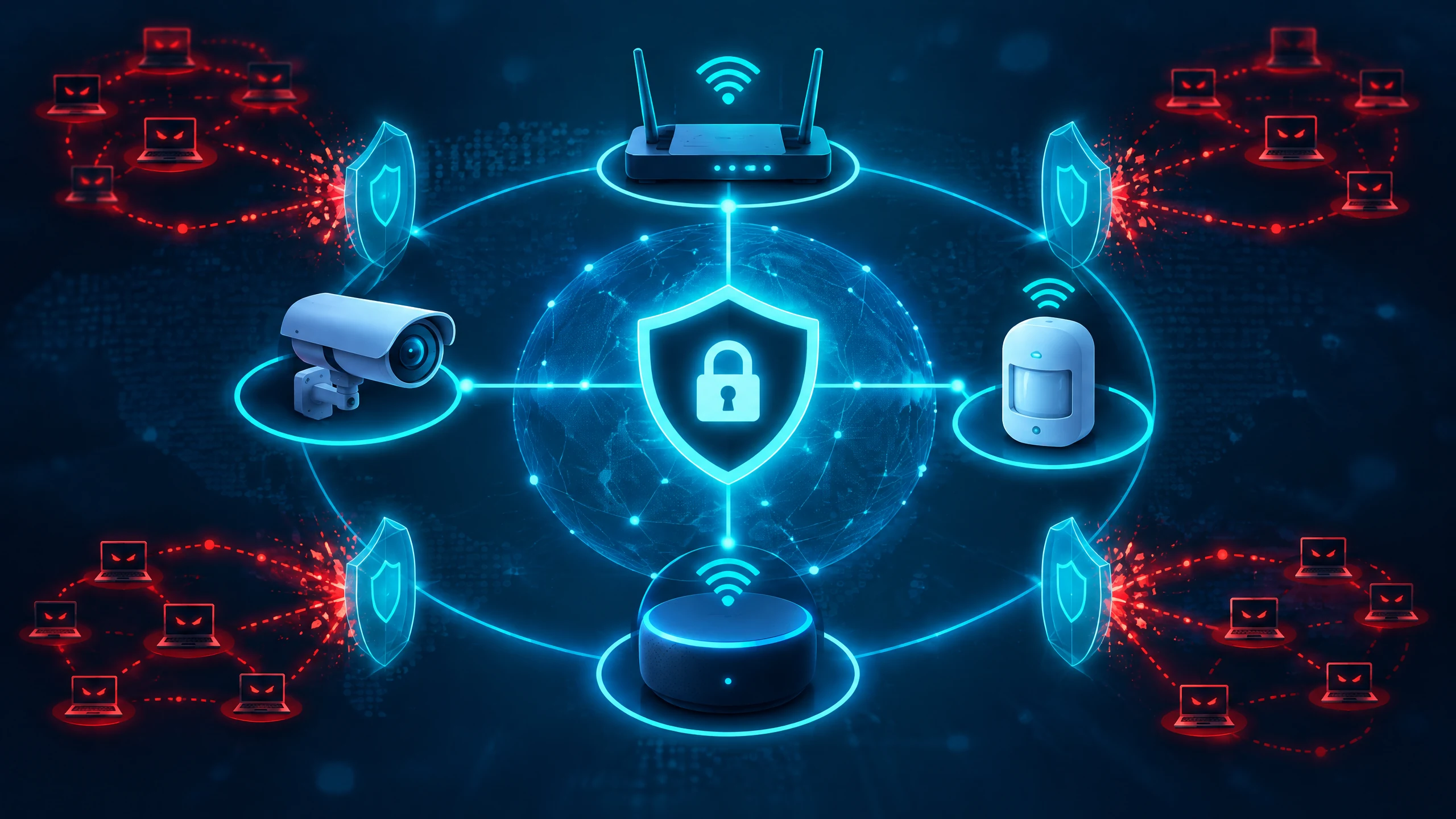
IoT botnet and connected-device security comes down to a simple question: can a device be reached, changed or abused by someone who should not control it? Routers, cameras, DVRs, smart TVs, printers, set-top boxes and other connected products can become botnet nodes when they use weak credentials, miss firmware updates or expose unnecessary services. The result may be DDoS traffic, unwanted scanning or other abuse carried out through equipment that its owner never intended to operate as part of an attack. The defensive answer is practical, not mysterious. Start with an accurate device inventory, replace default credentials, install supported firmware, reduce direct internet exposure, disable unnecessary features, separate devices from important systems and watch for unusual traffic. This guide explains the attack chain at a safe, defensive level and distinguishes historical advisories from newer standards work. It is written for households, small businesses, administrators, smart-building teams and product stakeholders, including readers looking for an India-relevant view. > **Key Takeaways > - An IoT botnet is a network of compromised connected devices controlled or directed by an attacker; CISA’s archived Mirai alert described scanning for vulnerable devices and using common default credential pairs. > - The most useful first controls are unique credentials, supported firmware, reduced internet exposure, unnecessary-service removal and network segmentation. > - Historical CISA and CERT-In advisories explain the mechanism and mitigations; they do not prove that the same malware or an equivalent outbreak is happening now. > - NIST’s IoT program treats security as a product-lifecycle responsibility, including maintenance, support, customer communication and end-of-life planning.
What is an IoT botnet and how does it form?
An IoT botnet is a group of connected devices infected with self-propagating malware or otherwise brought under an attacker’s control. The devices may be ordinary routers, network-enabled cameras, DVRs or other embedded products. CISA’s *Heightened DDoS Threat Posed by Mirai and Other Botnets* describes Mirai scanning for vulnerable devices and trying a short list of 62 common default username-and-password pairs. That historical alert is useful because it shows why basic device hygiene matters, but it is not evidence of a new 2026 outbreak.
The attack chain is usually easier to understand as four defensive stages: exposure, compromise, control and abuse. A device may be exposed through a reachable management service or a weak credential; malware then gains a foothold; the infected device communicates with command and control; and the operator directs a task such as traffic generation or scanning. The device owner may see little more than slower performance, an unusual reboot or a network connection that was never expected.
A botnet node is not necessarily a powerful computer. Its value comes from scale, availability and the trust placed in many small devices. A camera or DVR can be poorly maintained for years, while an administrator may not know it is running a service reachable from the public internet. That is why the [secure home router guide](https://cyberoinfo.com/cybersecurity-tools/browser-security) and a careful device inventory are more useful starting points than trying to identify every malware family by name.
How do IoT botnets abuse connected devices?
The direct answer is that compromised devices can be used as distributed infrastructure for an attacker’s instructions. A botnet may generate DDoS traffic, scan for additional targets, relay unwanted activity or consume the device’s bandwidth and processing capacity. The exact behavior depends on the malware and operator; a general botnet explanation should not be presented as proof that every infected IoT product performs every one of these actions.
CISA’s Mirai alert and India’s CERT-In advisory CIAD-2016-0086 both connect weakly protected embedded devices with DDoS-enabling risk. CERT-In’s historical list includes DVRs, CCTV/IP cameras, smart TVs, printers, webcams, home routers and set-top boxes. It identifies default credentials, missing firmware updates, exposed SSH or Telnet and weak maintenance as relevant risk factors. The advisory is historical guidance, so it supports the mechanism and controls rather than a claim about current Indian victim counts.
A vendor observation also needs careful wording. Cloudflare’s Q3 2025 DDoS report estimated 1–4 million infected hosts globally for the Aisuru botnet and reported attacks peaking at 29.7 Tbps in its network observations. The report is broader botnet evidence, and it should not be used to label every Aisuru host as an IoT device. Keeping those boundaries clear helps readers understand what is observed, what is inferred and what remains unknown. For wider defensive context, see CYBERoinfo’s [ransomware recovery and preparedness article](https://cyberoinfo.com/cybersecurity/ransomware-2026).
Which IoT botnet and connected-device security weaknesses matter most?
The highest-value weaknesses are often ordinary maintenance failures. Default or reused credentials can let an attacker pass the first gate; unpatched firmware can leave known weaknesses unresolved; and exposed administration services can give outsiders a path that the owner did not mean to provide. CISA and CERT-In both recommend changing default passwords, applying patches and disabling UPnP unless it is needed for a defined use case.
Remote administration deserves special care. Telnet and SSH are not automatically unsafe technologies, but an internet-facing service with weak authentication, unnecessary access or poor monitoring increases exposure. A safer design limits management to a trusted administrative path, uses strong unique credentials, removes unused accounts and records enough activity to investigate unusual attempts. If a product cannot receive updates or no longer has a supported security process, replacement may be safer than indefinite exposure.
Visibility is the foundation beneath those controls. Record each device’s owner, purpose, location, model, firmware version, network segment, support status and management path. Then classify whether it handles sensitive information, controls a physical process or only provides a low-risk convenience function. This [cloud security misconfiguration explainer](https://cyberoinfo.com/cybersecurity/cloud-security) is a related reminder that an asset that is technically connected still needs an intentional access boundary.
How can households and small businesses secure IoT devices?
The first practical step is to change every default credential and avoid reusing a password from another service. Use a unique administrator credential where the product supports it, remove unused accounts and enable stronger authentication options when available. Do not assume a device is safe because it is behind a consumer router: check the router’s remote-management settings, review port-forwarding rules and disable UPnP unless a specific, understood function requires it.
Next, update the device and its supporting components. Check the manufacturer’s support page or built-in update mechanism, confirm the firmware version and keep a record of the date and result. If a device is unsupported, cannot be updated or has no clear security contact, isolate it while planning replacement. Do not download firmware from an unverified source, and do not interrupt a vendor update process without following its documented instructions.
Finally, separate convenience devices from valuable systems. A home camera or smart TV does not usually need unrestricted access to workstations, backups or business administration systems. A small business can place cameras, printers and other devices on an IoT or guest segment, restrict management access and monitor unexpected outbound connections. These measures reduce the damage a compromised device can cause even when prevention is imperfect. The [cybersecurity tools guide](https://cyberoinfo.com/cybersecurity-tools/cybersecurity-tools) can help teams compare inventory, patching and monitoring functions without treating any single product as a universal answer.
What should administrators monitor and how should they respond?
Administrators should look for behavior that does not match a device’s purpose. Examples include repeated outbound connections to unfamiliar destinations, sudden traffic volume, repeated login attempts, unexpected DNS activity, unexplained reboots or a device communicating at unusual hours. A single signal is not proof of compromise; the value comes from comparing observed behavior with a known baseline and confirming the device’s owner and function.
When a device appears compromised, contain it safely before attempting a rushed cleanup. Restrict or isolate its network access, preserve relevant logs and note the time, device identity, firmware version and observed symptoms. Avoid spreading the device’s credentials to more people or connecting it to a sensitive network for testing. Follow the manufacturer’s recovery process, change credentials from a trusted device and update or replace the product before reconnecting it.
Response should also address the surrounding environment. Check the router, management accounts, port-forwarding rules, adjacent devices and any cloud account paired with the product. If the event affects an organisation, use its incident process and consider the relevant reporting and support channels; legal and regulatory obligations depend on context and current rules. For identity-related control planning, CYBERoinfo’s [phishing-resistant MFA guide](https://cyberoinfo.com/cybersecurity/phishing-resistant-mfa) covers a neighboring risk area without implying that MFA alone secures an unmanaged IoT fleet.
What does India-relevant IoT botnet and connected-device security guidance say?
India’s CERT-In advisory CIAD-2016-0086 is an important historical reference for connected-device risks. It names unsecured embedded devices, default credentials, missing firmware updates, exposed SSH or Telnet and weak maintenance as DDoS-enabling concerns. Its suggested countermeasures include changing defaults, applying updates, disabling UPnP unless needed and monitoring suspicious Telnet- or SSH-related activity. Because the advisory is from an earlier period, readers should treat it as foundational guidance and check current notices before acting on a time-sensitive requirement.
The India angle is operational as much as geographic. Homes, small offices, CCTV deployments, smart-building systems and public-service environments can contain devices owned by different teams, installed by different vendors and maintained on different schedules. A useful local checklist therefore records who is responsible, which support channel is valid, where logs are kept and how an unsupported product will be retired. It should not imply a current Indian outbreak, victim count or incident scale without dated evidence.
For manufacturers and enterprise buyers, NIST’s IoT Cybersecurity Program provides a lifecycle perspective that complements device-owner controls. The research evidence notes that NIST IR 8259 Revision 1 was published on 20 April 2026 and expands manufacturer guidance across pre-market and post-market activities, including maintenance, support, customer communications and end-of-life. That emphasis matters because connected-device security is not solved at purchase; it must continue through deployment, updates, support and retirement.
What changed in the evidence, and what remains uncertain?
The evidence points to a durable security problem rather than a defensible single headline about a 2026 IoT-botnet wave. CISA and CERT-In provide archived, mechanism-focused guidance; NIST published a 2026 revision that broadens lifecycle guidance; and ENISA’s *Threat Landscape 2026* describes a digital ecosystem shaped by geopolitical developments and growing interconnectedness. ENISA’s landing page does not, by itself, establish a specific IoT-botnet incident or metric, so it should not be stretched into one.
Public-interest signals also need restraint. The supplied Google Trends comparison showed normalized relative interest, not absolute query counts: the displayed average was 0 for “IoT botnet” and 8 for “IoT security.” The extracted series showed broader “IoT security” interest rising to 100 in October 2025 and displaying 14 in October 2026, while “IoT botnet” stayed near 0–4 in the displayed series; October 2026 was partial at the research date. These values do not prove volume, rankings, demand or a sustained trend.
The safest conclusion is therefore practical: connected-device security deserves attention even when a current incident cannot be established from the available evidence. Recheck device-maker advisories, CERT-In alerts, CISA’s Known Exploited Vulnerabilities information and current NIST or ENISA publications before publication or major remediation. Do not invent CVEs, Indian incident counts, botnet sizes or trend scores, and do not treat a vendor-observed botnet as IoT-specific without explicit support.
Frequently asked questions about IoT botnets
### Can a smart camera or router really join a botnet?
Yes, a connected device can become a botnet node if malware compromises it or an attacker gains control through a weakness such as default credentials, missing updates or exposed management access. The risk depends on the product, configuration, support status and network exposure; ownership of a camera or router does not by itself mean compromise.
### Is changing the default password enough?
No. It is an important first control, but it should be combined with firmware updates, reduced remote exposure, unnecessary-service removal, network segmentation and monitoring. A strong password cannot repair unsupported firmware or make an unnecessarily internet-facing service harmless.
### Should UPnP always be disabled?
Disable UPnP when it is not needed, which is the position stated in the historical CISA and CERT-In guidance used here. If a defined application requires it, understand what it creates, restrict exposure where possible and review the resulting router rules. The safest setting depends on the use case and the equipment.
### What should I do with an unsupported IoT device?
Reduce its exposure and isolate it from sensitive systems while you assess replacement. Do not rely on an unsupported product for a high-impact function merely because it still works. Record the retirement decision so that the device does not quietly return to service later.
Limitations
- Evidence and guidance can change; verify current advisories and organisational applicability before acting.
Evidence sources
- cisa.gov — CISA: Heightened DDoS Threat Posed by Mirai and Other Botnets
- cert-in.org.in — CERT-In Advisory CIAD-2016-0086: Distributed Denial of Service Attacks from non-traditional Sources
- nist.gov — NIST Cybersecurity for IoT Program
- enisa.europa.eu — ENISA Threat Landscape 2026
- blog.cloudflare.com — Cloudflare’s 2025 Q3 DDoS Threat Report
- trends.google.com — Google Trends comparison: IoT botnet and IoT security